When it comes to health and safety compliance in the UK, one of the most significant sources of confusion among business owners and managers is the difference between Legislation and Guidance.
It’s easy to see why. Both sources are official, both utilise legal terminology, and both are cited in safety documents and risk assessments.
However, understanding the distinction is essential, not only for compliance but also for proportional and effective risk management.
In this article, we’ll break down the difference between Legislation and guidance, explain why it matters, and show how to apply both correctly in your organisation.
What Is Legislation?
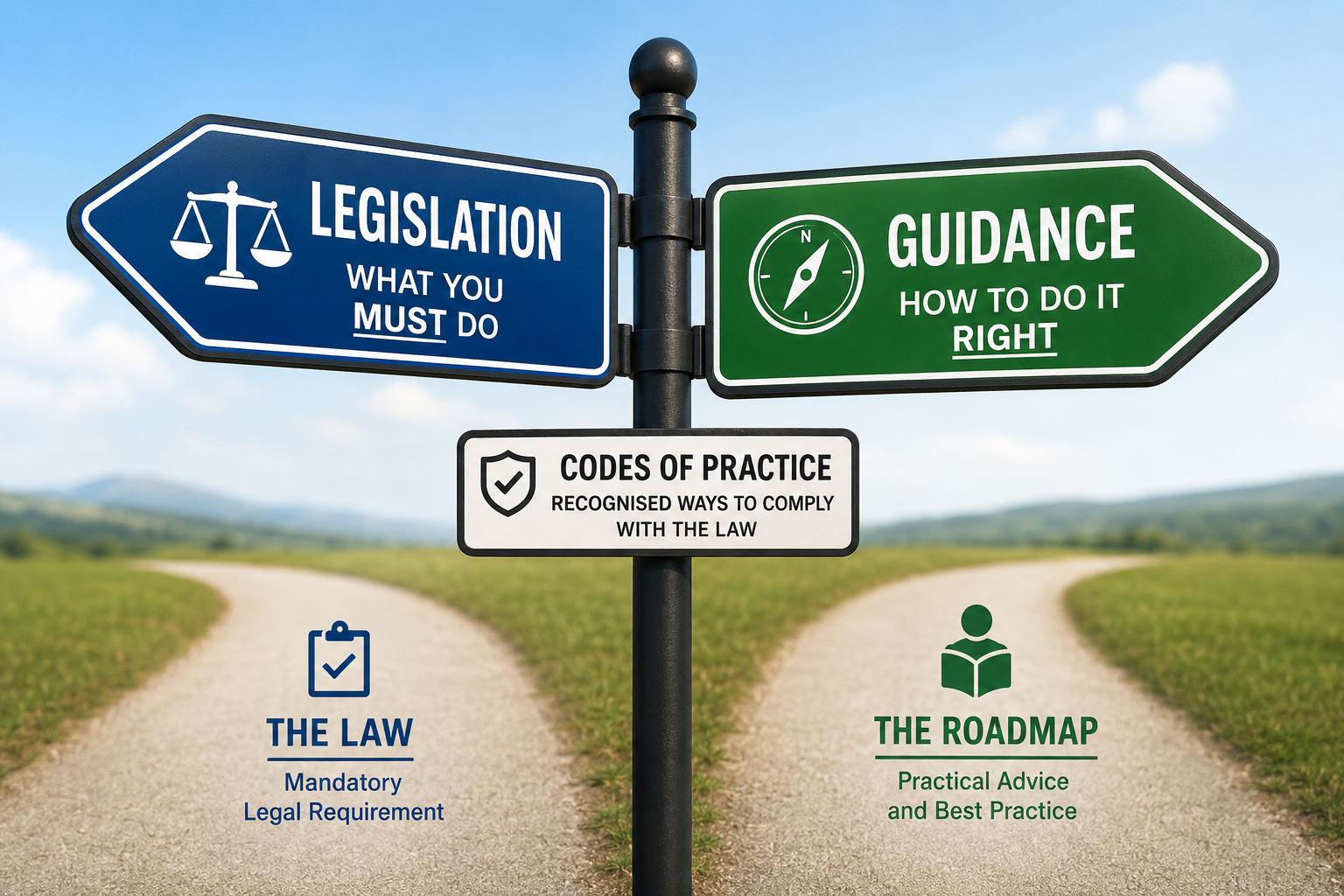
Legislation is Law. The mandatory standards businesses must meet.
If you fail to comply with Legislation, you’re breaking the Law, which can lead to enforcement notices, prosecution, or even imprisonment in severe cases.
Examples of core UK health and safety legislation include:
- Health and Safety at Work etc. Act 1974 (HSWA)
- Management of Health and Safety at Work Regulations 1999
- Control of Substances Hazardous to Health Regulations 2002 (COSHH)
- Workplace (Health, Safety and Welfare) Regulations 1992
These laws establish the minimum legal duty of care that employers, employees, and others must uphold.
In short, Legislation defines what you must do.
What Is Guidance?
Guidance provides
practical advice on complying with the Law.
It is not legally binding, but it carries considerable authority.
Guidance is often issued by:
- The Health and Safety Executive (HSE)
- Industry bodies such as the British Safety Council or IOSH
- Approved Codes of Practice (ACoPs)
While following guidance is not compulsory, it’s highly recommended because it’s written by experts who interpret Legislation in a practical, industry-specific way.
In short, Guidance shows how to meet legal requirements.
What Are Approved Codes of Practice (ACoPs)?
ACoPs sit somewhere between Law and guidance.
They are quasi-legal documents approved by the HSE that explain one recognised way to comply with the Law.
If you follow an ACoP, you are typically considered to have complied.
If you choose an alternative method, you must be able to
demonstrate that it is equally effective.
Example:
The
Control of Substances Hazardous to Health (COSHH) Regulations require control of exposure to harmful substances. The corresponding ACoP explains how to design and manage ventilation systems safely, not only how to comply, but also in a legally defensible manner.
Why Businesses Get It Wrong
Many businesses confuse guidance for “optional reading.” Others treat it as Law and unnecessarily overcomplicate their systems.
Here are the most common mistakes:
- Treating all HSE materials as Law.
→ Leads to excessive paperwork or irrelevant procedures. - Ignoring guidance completely.
→ Misses valuable insights that help achieve compliance efficiently. - Failing to differentiate between industry standards and Legislation.
→ For example, British Standards are not Law but can demonstrate compliance. - Copying policies from other sectors.
→ What’s legally sufficient in manufacturing might not apply to offices or hospitality.
Why the Difference Matters
Understanding what is required versus what is recommended helps businesses:
- Apply proportionate controls (avoid over- or under-regulation)
- Focus resources where risks are real and material
- Defend their position if audited or investigated
- Develop internal policies that reflect true legal obligations
A competent safety strategy utilises Legislation as its foundation and guidance as its roadmap.
How to Apply Both in Practice
1. Start with the Law
Identify the key Acts and Regulations that apply to your activities.
For example:
- Construction → CDM Regulations 2015
- Healthcare → COSHH and Manual Handling Regulations
- Offices → Workplace (Health, Safety and Welfare) Regulations
2. Use Guidance to Build Practical Controls
Once you understand your legal duties, utilise HSE and ACoP materials to determine the most efficient way to meet them.
This step prevents you from reinventing the wheel.
3. Document the Reasoning
In your policy or risk assessment, explain how guidance informed your controls.
If you deviate from an ACoP, record your rationale and supporting evidence.
4. Keep Guidance Up to Date
Guidance evolves faster than Legislation. Regularly review the HSE website or subscribe to updates.
Outdated practices can quickly erode compliance.
Real-World Example
A small manufacturing firm followed a 200-page safety manual copied from a construction company.
Most of the content didn’t apply to their processes, and crucial risks (such as dust exposure) were barely covered.
After reviewing the relevant Legislation and using HSE guidance on LEV (Local Exhaust Ventilation), they:
- Cut unnecessary procedures by 60%
- Improved COSHH compliance
- Reduced audit findings significantly
By distinguishing Law from guidance, they became safer and more efficient.
Summary: Clarity Brings Confidence
Legislation tells you what you must do.
Guidance helps you do it right.
Understanding both gives you confidence whether writing a policy, auditing a site, or explaining compliance to a client or regulator.
When businesses confuse the two, they either do too little or too much. The smart ones strike the right balance.